idle: the hallway you lost after college

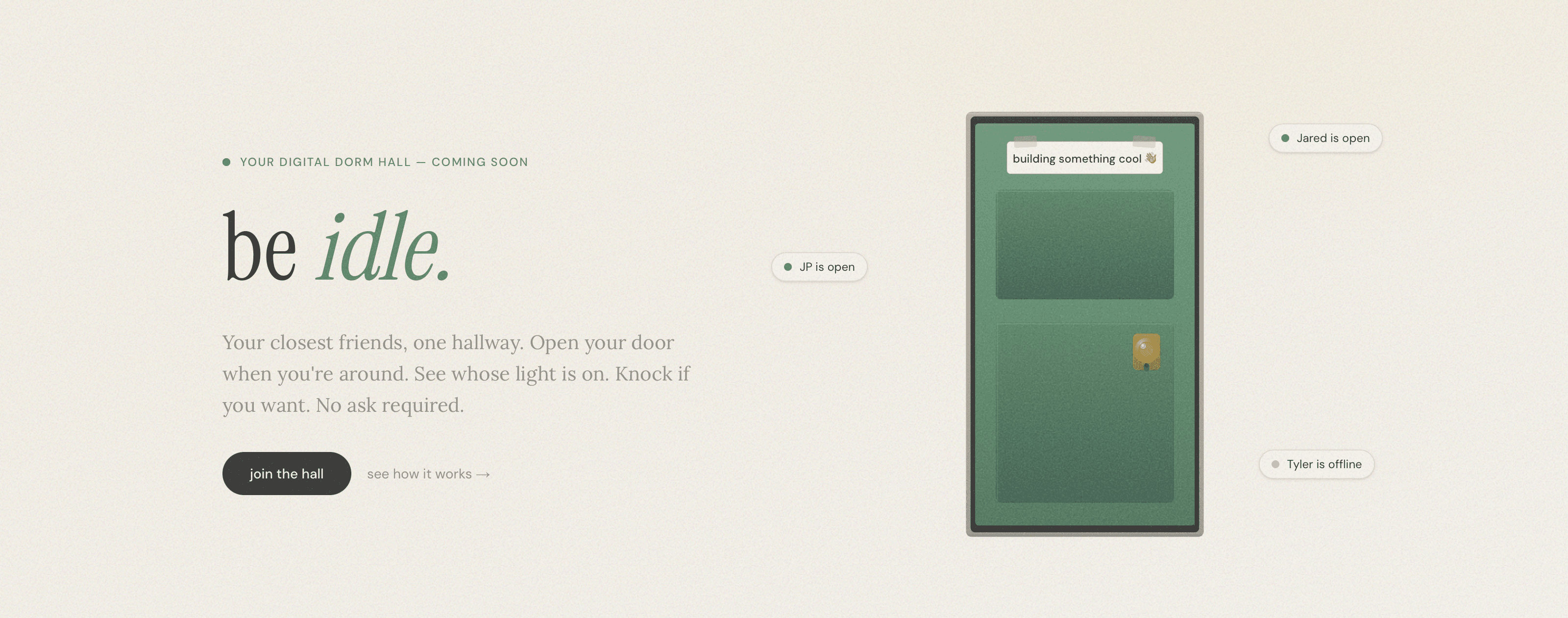
Table of Contents
The Problem
in college i had like 15 friends within a 200-foot radius at any given time. i didn't plan hangouts — i just left my door open and people showed up. someone would walk by, see my door cracked, poke their head in like "you tryna get food?" and suddenly it's 11pm and we're at the teriyaki place arguing about whether mid means bad or average. zero coordination. zero planning. you were just around.
then you graduate and that disappears overnight.
i moved to seattle, got a job, got an apartment. i have friends here, good ones. but hanging out became this whole production — you text someone, they're busy, you try next week, someone cancels, you reschedule, and eventually you just stop trying for a while because the activation energy is too high. and it's not that anyone stopped caring. it's that the infrastructure of proximity went away. nobody's door is open anymore because nobody has a door. you're all in separate apartments staring at separate screens and the only way to know if someone's free is to ask, which already feels like a commitment.
i think this is why so many post-college friendships just quietly fade. not from conflict, not from drama — from drift. you stop bumping into each other and the friendship slowly goes from "we hang out twice a week" to "we should catch up sometime" to an instagram story reaction every few months. and you don't even notice it happening until it's already happened.
laura gutierrez wrote a really good piece about this called "catch-up culture is killing friendship" that i think nails the deeper version of what i'm describing. her argument is that adult friendships have turned into these scheduled exchanges of life updates — you meet up every few weeks, take turns summarizing what happened since last time, and leave feeling like you maintained the friendship. but did you? she makes this distinction between narrating your life to someone and actually living alongside them, and i think that's exactly right. "we confuse telling things with truly sharing... we share what we have done, not the experience of doing together."
the whole thing hit me because she describes how even living within a two-mile radius of her childhood friends, coordinating a single evening feels like a diplomatic summit. shared spreadsheets, weeks of planning. and i'm like yes, that's the problem. the friendship isn't dead — the infrastructure is. we replaced spontaneous coexistence with logistics. and the worst part is we don't even question it because that's just how adult friendship works now, apparently.
she also cites a sociologist who says friendship has become "a sort of task, a kind of capital you have to manage so that it pays off." which is bleak but also... yeah. when you're mentally calculating whether you have the energy to plan something this weekend, you've already lost the thing that made hanging out good in the first place — the effortlessness of it.
anyway that's the headspace i've been in for the last year. which is how i ended up building a social app (i know, i know).
What idle Actually Is
idle is a digital hallway for your closest friends. that's it. there's no feed, no algorithm, no content, no stories. you open your door when you're around, you see who else has their door open, and you can knock if you want. the whole thing is modeled after a college dorm hallway because honestly that's the best social infrastructure humans have ever invented and we just abandoned it after graduation for some reason.
the core loop takes like 30 seconds: open the app, open your door (which is just a toggle that says "i'm here"), see who's around, maybe knock on someone's door or drop into the common room. that's the whole app. i'm not being reductive — that's genuinely it.
your door has a little note you can set, like "building something dumb" or "bored, someone come get food" or just nothing. it auto-closes after a few hours so you don't have to remember to update it. you can customize it with different styles and colors and stickers which is mostly just fun and not important but also i spent way too long on the sticker system so i'm mentioning it.
The Three Things
i made a deliberate decision early on: idle does three things. not four, not twelve, not "and we're also building a marketplace." three.
1. open your door
you toggle your status to open. that's a passive signal — you're not texting anyone, you're not making plans, you're just saying "i'm around." your friends see your door open in the hallway. maybe someone knocks, maybe nobody does. either way is fine. it's the digital equivalent of leaving your dorm room door cracked with music playing.
2. knock on their door
you walk down the hall (scroll the list) and knock on someone's door. this sends them a quick voice memo — not a text, a voice memo. i did this intentionally because voice conveys tone without the pressure of composing a message. "hey you wanna grab dinner" hits different when you can hear that someone's being casual about it vs. a text that could be read in any tone. knocks expire after 23 hours because nothing in idle is permanent and i think that's important.
3. the common room
there's a shared space at the end of the hall. max 6 people. you just drop in and whoever's there is there. voice and video, ephemeral — nothing gets saved. friends of friends can wander in too, which is how you actually meet new people in real life (someone brings someone to the hangout and you vibe). the common room is basically the dorm lounge and i think it might be my favorite part of the app.
that's it. three features. i get asked constantly "are you going to add X" and the answer is almost always no. the constraint is the product. every social app starts simple and then bolts on features until it's facebook. idle is aggressively not doing that.
What idle Isn't
i should probably address the elephant in the room which is that nobody needs another social app. i agree! i don't want idle to be a social app in the way that phrase usually means. there's no content to consume, no likes, no followers, no viral mechanics. you can't have more than 150 friends (dunbar's number, look it up, it's a real thing). there's no growth hacking because the product literally doesn't work if your hall is full of strangers.
idle is closer to a walkie-talkie than a social network. it's a utility for people who already know and like each other. if you don't have close friends you want to stay connected with then idle isn't for you and that's okay. i'm not trying to connect the world, i'm trying to keep my group chat from becoming "haha" reactions to memes once a month.
also — and i feel strongly about this — idle doesn't sell your data. there's no analytics SDK phoning home to mixpanel. no location tracking. no contact harvesting. messages are end-to-end encrypted. everything is ephemeral by design. i built this for my friends and i use it every day and i would feel gross if it was doing creepy stuff in the background. core features are free forever. there's an idle+ subscription for $1.99/month that gives you premium door cosmetics and that's the business model. stickers pay the server bills. i think that's honest.
Open Beta
idle is now in open beta on iOS and Android. the landing page is at beidle.app where you can sign up and download. you'll need to invite a few friends to make it worth using — an empty hallway is just a hallway. the whole thing works best when you get like 5+ people from your actual friend group on it. i know that's a big ask but i genuinely think once you try it for a week you'll get why it clicks.
if you're the kind of person who misses spontaneous hangouts, who's tired of the "when are you free" text chain, who thinks the best moments with friends are the unplanned ones — this is what i built idle for. it's not going to replace your group chat or your instagram. it's the thing you open when you're just... around. and you want to see who else is.
come be idle, together.
if you have feedback, bugs, ideas, complaints, or just want to say hey — [email protected]. i read everything.